

Zprávy o bojích v Charkově. Aktuálně a přehledně.

Pro obsáhlost komentářů a špatné načítání a zpětné dohledávání informací zakládám tuto diskuzi. Nově si budeme zprávy psát sem. Dle nových zpráv jsou Rusové v Charkově, kde probíhají boje v ulicích.
Stručné shrnutí
- Ruské obrněné kolony pronikly do Charkova a v ulicích probíhají boje, přičemž byly hlášeny ostřelování obytných čtvrtí a útoky na sanitky.
- Místní úřady později oznámily, že ukrajinské síly opět plně kontrolují Charkov.
- Mezinárodní reakce zahrnují rozsáhlé sankce a omezení (odpojení bank od SWIFT, zmrazení devizových rezerv), uzavírání vzdušného prostoru pro ruské lety a dodávky zbraní EU v hodnotě 450 milionů EUR; jednotlivé státy oznamují konkrétní příspěvky (Dánsko až 2700 protitankových zbraní, Švédsko 5000 protitankových střel, helmy a štíty).
Nejčastější otázky
Q: Co se děje v Charkově?
A: V Charkově pronikly ruské obrněné kolony a v ulicích probíhají boje; místní úřady následně oznámily, že ukrajinské síly opět plně kontrolují Charkov.
Q: Jakou vojenskou pomoc posílá EU a evropské státy na Ukrajinu?
A: EU schválila financování dodávek zbraní a pomoc v celkové výši 450 milionů EUR včetně letecké podpory; Dánsko oznámilo dar až 2700 protitankových zbraní a Švédsko slíbilo 5000 protitankových střel, helmy a štíty.
Q: Které země uzavřely vzdušný prostor pro ruská letadla?
A: Ve zmínkách v diskuzi se uvádí, že Francie, Švédsko, Finsko, Dánsko a Kanada uzavřely svůj vzdušný prostor pro ruské lety; EU také uvedla, že uzavře vzdušný prostor pro veškerý ruský provoz.
Q: Jaká finanční opatření vůči Rusku se připravují?
A: Diskuse zmiňuje odpojení klíčových ruských bank od systému SWIFT, zmrazení devizových rezerv ruské centrální banky a zákaz transakcí pro vybrané ruské instituce a představitele.
Q: Jsou hlášeny útoky na civilní infrastrukturu a nemocnice?
A: Ukrajinský prezident a místní zdroje uvedli, že ruské jednotky zasahují civilní infrastrukturu včetně mateřských školek, obytných domů a sanitních vozidel; v diskuzi jsou citovány konkrétní případy ostřelování obytných čtvrtí.
Q: Kde najdu aktuální varování o náletech a satelitní záběry konvojů?
A: Výstrahy před nálety zveřejňoval například Kyiv Independent, satelitní snímky kolony poskytla firma Maxar a zpravodajské servery zmíněné v diskuzi zahrnují iRozhlas, SeznamZpravy a iDNES.cz.
Závěry z diskuze
Shoda
- Ruské jednotky ostřelují a útočí na civilní infrastrukturu, včetně nemocnic, obytných domů a záchranných vozidel.
- Západ reaguje sankcemi, odpojením bank od SWIFT a omezeními letového provozu pro ruské aerolinky.
- Evropské státy a EU zvyšují vojenskou pomoc Ukrajině včetně protitankových zbraní a finančních balíků (např. 450 milionů EUR).
Sporné názory
- Názor 1: Někteří tvrdí, že útoky na civilní objekty jsou „omyl“ nebo dílčí zásahy z nepřesnosti zbraní.
- Názor 2: Jiní uvádějí, že ruské síly cíleně zasahují civilní infrastrukturu a že jde o součást agresivní strategie.
Otevřené otázky
- Podaří se mírová jednání mezi Ruskem a Ukrajinou dosáhnout příměří a za jakých podmínek?
- Existuje reálné riziko nasazení jaderných zbraní nebo „špinavé bomby“ a jaké jsou možnosti jejich odhalení a obrany?
- Jaký bude dlouhodobý dopad sankcí na ruskou ekonomiku a na evropské dodavatelské řetězce?
Zmíněné značky a firmy
Google, Gazprom, Sberbank, Maxar, Anonymous, Kyiv Independent, Reuters, TASS, AP, UNIAN, OBOZREVATEL, SeznamZpravy, iRozhlas, Novinky.cz, iDNES.cz, Echo24, Fio (transparentní účet), Evropská komise, NATO, OSN, Mezinárodní soudní dvůr, FAČR, Mezinárodní judistická federace, Milion chvilek pro demokracii
Zmíněné produkty a metody
Iskander, Javelin, termobarické zbraně, protitankové střely, B-52H Stratofortress, špinavá bomba, jaderné zbraně (stav pohotovosti), SWIFT, zmrazení devizových rezerv ruské centrální banky, hackerské útoky Anonymous, demonetizace ruských státem financovaných médií (Google)
Místa a osoby
Charkov, Kyjev, Černigov, Sumy, Bucha, Irpin, Záporoží, Berdjansko, Balaklija, Polská hranice, Bospor a Dardanely, Brno, Bratislava, Praha, Berlín, Mallorca, Rusko, Bělorusko, Švédsko, Dánsko, Finsko, Kanada, Evropská unie, Mezinárodní soudní dvůr, Volodymyr Zelenskyj, Vladimir Putin, Dmitrij Peskov, Sergej Šojgu, Ramzan Kadyrov, Hanna Malyar, Vitalij Kličko, Ursula von der Leyen, Josep Borrell, Mette Frederiksen, Magdalena Andersson, Scott Morrison, Ignazio Cassis, Naftali Benett, Patrik Tušl

Z Facebooku (úvaha o tom, pro západ nebezpečně misinterpretuje některé tahy ruské armády, především letectva, jako neschopnost a jak jsme za léta míru zapomněli na základní pravidlo "umění války", totiž "znej svého nepřítele"):
Tom Cooper
22 hod ·
Some know me as ‘confrontational’ and ‘undiplomatic’. Thus, a sort of ‘warning’, up front: this is definitely going to (re)inforce such an impression.
I grew up at the times the motto ‘know your enemy’ was in high esteem in numerous armed forces, no matter where. At the time when, for example, the discipline of researching the Soviet Armed Forces was taken very seriously, and people involved knew what were they talking about: so much so, they could literally ‘read the minds’ of decision-makers in Moscow and few other places.
Now, my point of view was that a World War III is unlikely to ever happen, because there was enough rationale in the East and the West, and thus nobody would risk the ‘ultimate option’. So, ‘why waste time’ studying, for example, the Soviets? Still, I was fascinated by ‘know your enemy’ kind of works, and thus ‘spent’ much of my professional career studying what some consider ‘obscure’ or ‘small’ air forces; and others for ‘enemy’ – especially so in the Middle East and Africa. It’s only more recently – say: 7-8 years – that I’ve ‘added’ the modern-day Russian armed forces to what’s interesting for me, and then primarily because of the Russian military intervention in Syria.
What surprised me when ‘returning’ to something I ceased studying around the time people like Benjamin Lamberth, Bill Sweetman and few others have ceased publishing their books (‘back in the 1990s or so’) was that it seems that over the last 30 years, the skill of ‘know your enemy’ has been misdeclared into ‘support for jihadism’, while understanding of the Russian armed forces appears to have degenerated into oblivion. This became obvious not only ‘already’ during the first two years of the Russian military intervention in Syria (2015-2017), but even more so since the Russian (re)invasion of Ukraine, on 24 February 22. Ever since, most of notable think-tanks and their experts seem to be falling over each other in an entirely new Olympic discipline: how to mis-understand and mis-explain the Russian Armed Forces, and the Russian Air-Space Force in particular.
What is particularly astonishing in this regards: back in 2016, the Foreign Military Studies Office of the US Army, published the book ‘The Russian Way of War: Force Structure, Tactics, and Modernisation of the Russian Ground Forces’, by Lester W. Grau and Charles K. Bartles.
The book is available as a free download (as PDF) for years already. I.e. everybody can have it. Just go to this link: https://www.armyupress.army.mil/.../2017-07-the...... – download, read, and inform yourself.
Sure, Grau and Bartles concentrated on the ground forces. But, they explained so much and so well about the structure, thinking, practices, doctrine, strategy and tactics of the entire Russian armed forces that I simply can’t believe anybody is still coming to the idea to write anything about the ‘Russian military’ – without, first, reading their book and, second, keeping it in mind all the time.
And still: this is the case – and so we get to hear how the Russian Air-Space Force (VKS) is a ‘non-appearance’ in this war, how it ‘can’t own the skies’ over Ukraine, indeed, that it is ‘incapable of running complex operations’.
Those who follow me since longer than 3-4 days should know better: should know that the VKS is no ‘USAF East’. As explained earlier, the VKS is simply never meant to fight the way Western air forces do.
As nicely explained by Grau and Bartles, and confirmed in reality only some 17-18 zillion of times, in Russia, there is only one authority that’s thinking what are future wars going to look like, and – therefore – how should it organise, equip, and train the Russian armed forces. This authority is the General Staff of the Armed Forces of the Russian Federation. Short: GenStab. Because of its task, the GenStab is also the sole military procurement authority in Russia: it is responsible for the purchase of everything, from screws, via fighter jets, to intercontinental ballstic missiles and their nuclear warheads.
To keep it compressed, the GenStab considers the VKS for something like ‘extended range artillery’: a branch meant to cover tasks from provision of close air support, to interdiction strikes up to around 100, perhaps 150km behind the frontline. For this reason, the VKS has a purely supportive role, through and through: it is meant to – and equipped to - establish air superiority only over the frontlines, and then support ground or naval forces. Strikes deep into the enemy-controlled territory are a business of missile forces, and forces equipped with cruise missiles. Search and destroy enemy air defences (SEAD)? Yes, but along the frontline only. Therefore, and even if operating such ‘powerful, super-turbo-Wunderwaffen’ like Su-27SM, Su-30SM, Su-34 and Su-35s, the VKS is simply not equipped to ‘go places’, ‘rule the skies’, ‘dominate’ etc. into the depth of the enemy territory. Not away from the frontline.
When somebody not knowing about this now tries to monitor the VKS operations in Ukraine from the Western standpoint, plenty of things are incomprehensible and wrong conclusions simply unavoidable. What the Russians are doing there is contrary to the very essence of the Western – and especially: US – thinking, where the air power is dominating: much to disgust of its own ground forces, it is frequently fighting ‘its own war’. It first seeks to establish air superiority over the enemy, destroy its air power and the capability to defend itself from air power, and only then supports own ground troops or naval forces.
If the VKS then does not behave that way, ‘logical conclusion’ is ‘it failed’ and ‘can’t’.
Actually, the VKS is doing its job very well. It rules the skies – above the frontline. As the sustained losses of the Ukrainian Air Force over the last 13 days have shown: whenever Ukrainian Su-25s try to hit the Russian ground forces, they are shot down. Whether by VKS interceptors, or by ground-based air defences. Presence of ‘heavy’ Ukrainian air defences near the frontline is minimal. In turn, the VKS is all the time flying – ‘BUT’ over the battlefield. Between seven and eight of its aircraft are airborne over the Chernihiv, Kharkiv, and Mariupol areas all the time during the daylight, every single day ever since 24 February. As predicted, the sky there is really ‘black’ of all the VKS aircraft. This is a co-reason why are they suffering losses to the Ukrainian ground-based air defences, too: they are present so much and so often, that the Ukrainians can recognise patterns in operational behaviour of Russian pilots and ‘ambush’ them.
(The other co-reason is that the Ukrainians have got so many MANPADs from the West, they’re firing them by dozens, every day. There are several videos showing them firing 6-8 missiles at one target: we only get such scenes much too rarely to see, and even less so would the Ukrainians brag how often they miss.)
Contrary to the claims of the Ukrainian politicians, the VKS pilots also do not refuse to fly: they go as far as to do things Western pilots would rarely do. Like such a dumb idea to descend below the cloud cover in order to acquire a target and bomb it – only to get shot down by 5-6 MANPADs fired in return.
All of this means that conclusions like ‘VKS is not flying’, ‘VKS can’t run complex operations’ etc. are all wrong. By all the (meanwhile: ‘proven’) military incompetence of Putin, Shoygu, Gerasimov, even the officers of the GenStab, not to talk about numerous of Russian generals in the field, the VKS is fulfilling precisely the duty for which it was equipped and trained – all along the doctrine developed by the GenStab.
This are the ‘Reasons No. 1-100’ of why we’re never going to see VKS’ Su-34s roaming the skies of Ukraine all the way to the Romanian border, using R-77s to shot down Ukrainian Su-27s, while deploying PGMs to precisely destroy MiG-29s or Su-25s on the ground, and yet other PGMs to knock-out Ukrainian air defences - free along the motto: like in a video-game...
Talking about VKS and PGMs: Colonel Andrew J Bachevich (US Army, ret.) – one of less than a handful of sober, balanced, and serious military historians left in the USA - has explained it in his TV-appearances already years ago. When invading Ukraine, in 2014, Russia lost the control and contact to about 120 major arms-manufacturing enterprises – including about 50 manufacturing the host of PGMs in the VKS service. Ever since, the GenStab did try to re-establish some of production at home, but this was largely spoiled – both because of the endemic corruption of the Putin-regime, and because of resulting sanctions, which cut off Russia from approach to the necessary know-how and high-tech.
‘What a surprise’ then, that Russia can’t run large-scale production of PGMs, that the few that are available are either from stocks manufactured back in the 1980s and early 1990s or astronomically expensive and thus not affordable for the GenStab; or that the VKS never got enough money to buy new PGMs, and thus has next to none to deploy in combat operations. Indeed, that it has to send its Sukhois with a price tag of US$40-50 million apiece into low-altitude strikes armed with ‘dumb’ bombs.
Bottom line: stop trying to understand and explain the VKS by Western – especially US – way of thinking. If you want to understand and explain it, you need to see it entirely from the Russian point of view, and also to consider plenty of factors that are anything else than ‘directly related to air power’. I simply can’t but repeat myself: keep the big picture in mind.

@odula Odkaz na člověka https://www.facebook.com/keksifarm.hayday a znova odkaz na knížku (asi se špatně zkopíroval z příspěvku, tak kopíruju url, šlo mi to nomálně otevřít, jen se to dýl načítá) https://www.armyupress.army.mil/portals/7/hot s...
At se prihlasi ten, kdo jim jeste neco veri 😐 https://www.novinky.cz/zahranicni/evropa/clanek...
Myslím, ze jim teče do bot, tak zase strasej. Nevim, jako jsem laik, ale pokud Ukrajinu neporazi, tak nebudou mít snad za chvíli z čeho brát na válku peníze. Pak je otázka, jestli to tam radši nesrovnaji se zemi, než aby “prohráli” každopádně - údajně se prohrany války v Rusku neodpousti a často po prohrany válce přicházela výměna vedeni. Dávám do toho trochu naděje.
Sice Novinky.cz, ale ciujou BBC. Reakce na ultimátum - vicepremiérka kulantně zvedla prostředníček 🙂 https://www.novinky.cz/valka-na-ukrajine/clanek...
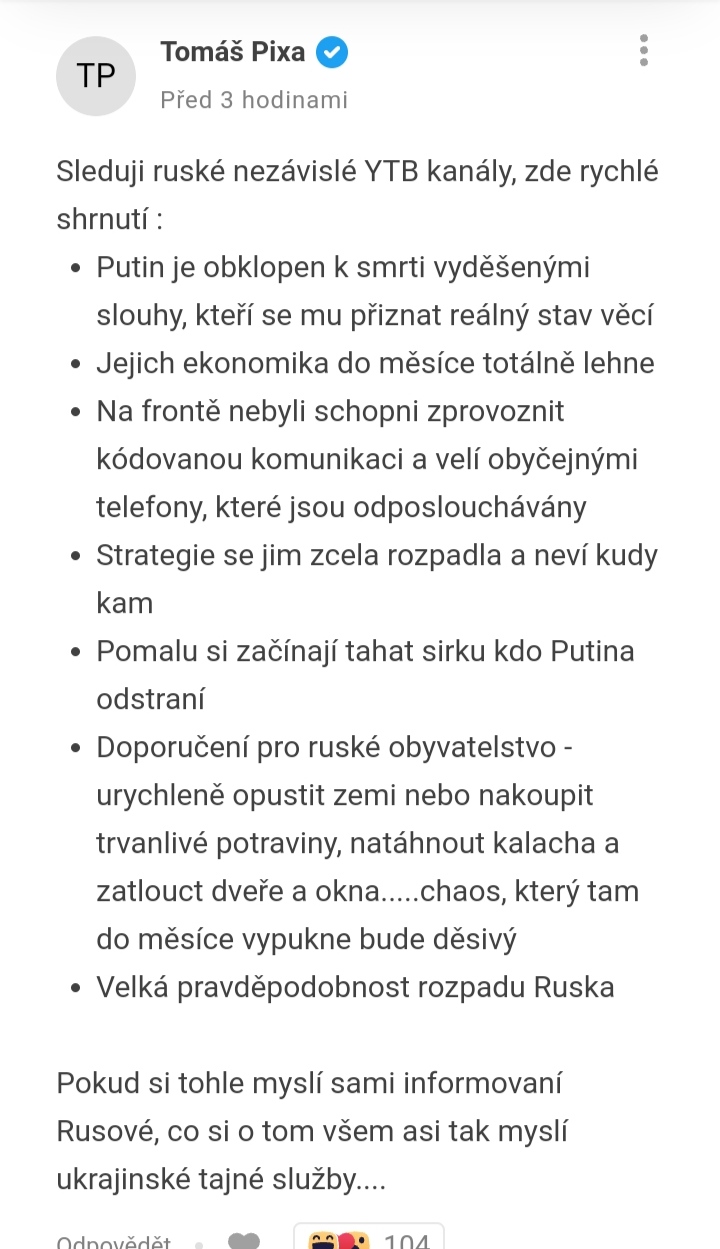

@pampeliska1313 dyt to není válka..dle Putina tam dělají mírovou misi 🤪
Ne fakt dělám si srandu...doufám, že se ho někdo zbaví 🙏🙏🙏
Lidé spojení s ruskou tajnou službou FSB začali masově prodávat byty na Krymu. Ví něco, co my ne?
https://twitter.com/TsybulskaLiubov/status/1501...
Evidujeme desítky podnětů na komentáře v internetových diskusích, schvalující ruskou invazi a aktivity ruské armády. Internetové prostředí pečlivě monitorujeme a omlouváme se, že nereagujeme na každé označení v příspěvcích. Není to vždy žádoucí a taktické. Děkujeme za pochopení!
S tím, jak používají Rusové nešifrovanou komunikaci, slýcháme pěkné hrůzy. Jak se třeba chlubí ženám a přítelkyním, jaké cennosti z Ukrajiny přivezou, často od zabitých civilistů (odporné rabování a okrádání mrtvých proběhlo i po sestřelení malajského letadla). Opravdu to asi nebudou jen samí chudáčci, co nevěděli, kam jedou. Twitter je toho plný a teď i novinky
https://www.novinky.cz/zahranicni/evropa/clanek...


Úřady v obléhaném Mariupolu oznámili, že ruská armáda začala bombardovat zelený koridor, který je určený pro evakuaci civilistů z města.
A co se mezitím řeší v Rusku
Rusové obviňují zahraniční firmy, které opustily RF, že ukradly jejich peníze, protože přestaly fungovat slevové karty.
U Brovar na východním předměstí Kyjeva přešli Ukrajinci do útoku a podle svých zpráv pošramotili 6. tankový pluk 90. tankové divize. Na videu jsou scény z boje, jak jde vidět, je to pozemní útok, asi koordinovaný s útokem dronů Bayraktar TB-2. Podle zpráv padl i velitel plk. Zacharov. Z videa je ovšem obtížné vyčíst objem ruských ztrát, minimálně ale jdou vidět tři ztracené T-72 a možná i systém Pancir S-1, které, to si nejsem jistý, asi opětuje palbu proti vzdušnému cíli. Každopádně se potvrdilo, že na východě Kyjeva se schyluje k protiúderu. Na západě se zatím Rusové snaží obsadit Makariv, kde také zuří boje.
Poslanec ODS Janda prosadil v dílčím hlasování o rozpočtu zrušení milionové dotace svazu bojovníků za svobodu, peníze si rozdělí jiné organizace.
Ovšem teď se už Rusky musí vzbouřit, činnost v Rusku a Bělorusku pozastavila Pandora.
Z ruského fóra. To vypadá, že tamní cenzor spí. Přeloženo Googlem:
"Za svůj život si nepamatuji, jak byl zvolen prezidentem, ale znovu, za svůj život, nechápu, JAK jsme ho mohli zvolit."
A další. Je to reakce na to, že: "Místopředseda Rady bezpečnosti Ruské federace Dmitrij Medveděv pozdravil zahraniční firmy opouštějící Ruskou federaci s tím, že pro ně nebude snadné vrátit se na ruský trh. Medveděv o tom napsal na sociálních sítích. Připomněl události z roku 2014, kdy „úsilím Západu byla také od nuly zařízena panika a byly uvaleny sankce“. Rusko dokázalo zajistit potravinovou bezpečnost řešením řady problémů v oblasti nahrazování dovozu. "Teď už to zvládneme. Koneckonců, sami umíme vyrábět řízky a rohlíky vynikající kvality. Mimochodem, podnikatelé, na které se vztahují sankce, by to mohli udělat. Ahoj McDonald's!" uzavřel.
Skvělý!
a kde seženeme suroviny na rohlíky a řízky?
A co trouby a digestoře? pokladny? nádobí atd. atd. ...
a mnoho dalšího, co všemožné spotřební zboží hasiči kontrolují ...
ach! tady jsem... znárodňujem!!! přesně tak!
Také zajímavý příspěvek. Je z minulého týdne. "Zdá se, že ztrácím rozum. Peníze se mi před očima mění v písek.
Byla potřeba kamna - topeniště stálo 37 tisíc, nyní :pomlčka:je k němu potřeba ještě 53 trubek a stojí stejně jako sporák. Jak čerpat 40 tisíc?
Ve 14 to nebylo ono, chtěla jsem dát dítěti na Nový rok kvadriku, stála 35 a druhý den 50, ale bylo to tam nějak měkčí a tam se ta cena jen zvýšila a ne všechno. zmizela.
Promiňte."


https://www.novinky.cz/zahranicni/clanek/ukraji...
Zase to debilní červený tlačítko, ať s tím dají pokoj, fakt už jako…